Download this portfolio as PDF
Gerardo Ezequiel Martín Carreño
Technology direction from product question to architecture, evidence controls and delivery plan.
me@gerardoezequiel.xyz · gerardoezequiel.xyz · linkedin.com/in/gerardoezequiel · London
CommunityAI
Technical direction for an early-stage community-intelligence proof of concept, within a collaborative founding team.
As CTO-designate within the collaborative founding team, I set the technology and data direction and led the open-data rebuild. I develop bespoke spatial models to explore audience geography, location choices and media allocation within the proof of concept. I designed the data architecture, source and licence records, spatial validation and release checks, and built a test of whether candidate signals add predictive value beyond agreed baselines, keeping customer-specific validation separate.
As CTO-designate within the collaborative founding team, I set the technology and data direction and led the open-data rebuild. I develop bespoke spatial models to explore audience geography, location choices and media allocation within the proof of concept. I designed the data architecture, source and licence records, spatial validation and release checks, and built a test of whether candidate signals add predictive value beyond agreed baselines, keeping customer-specific validation separate.
- CTO-designate mandate following a technical audit and staged platform roadmap.
- An open-data architecture with documented sources, processing and model provenance.
- Spatial holdouts and baseline comparisons built into validation.
- Release controls distinguishing research outputs from customer-specific validation.
Where the work stands: This case describes my technical mandate within a founding team, not ownership or proven customer impact. Detailed architecture and results remain confidential. Predictive signals do not establish causal effects.
Climate Intelligence
An open-data climate console connecting a product question to source adapters, assessment logic and an inspectable interface.
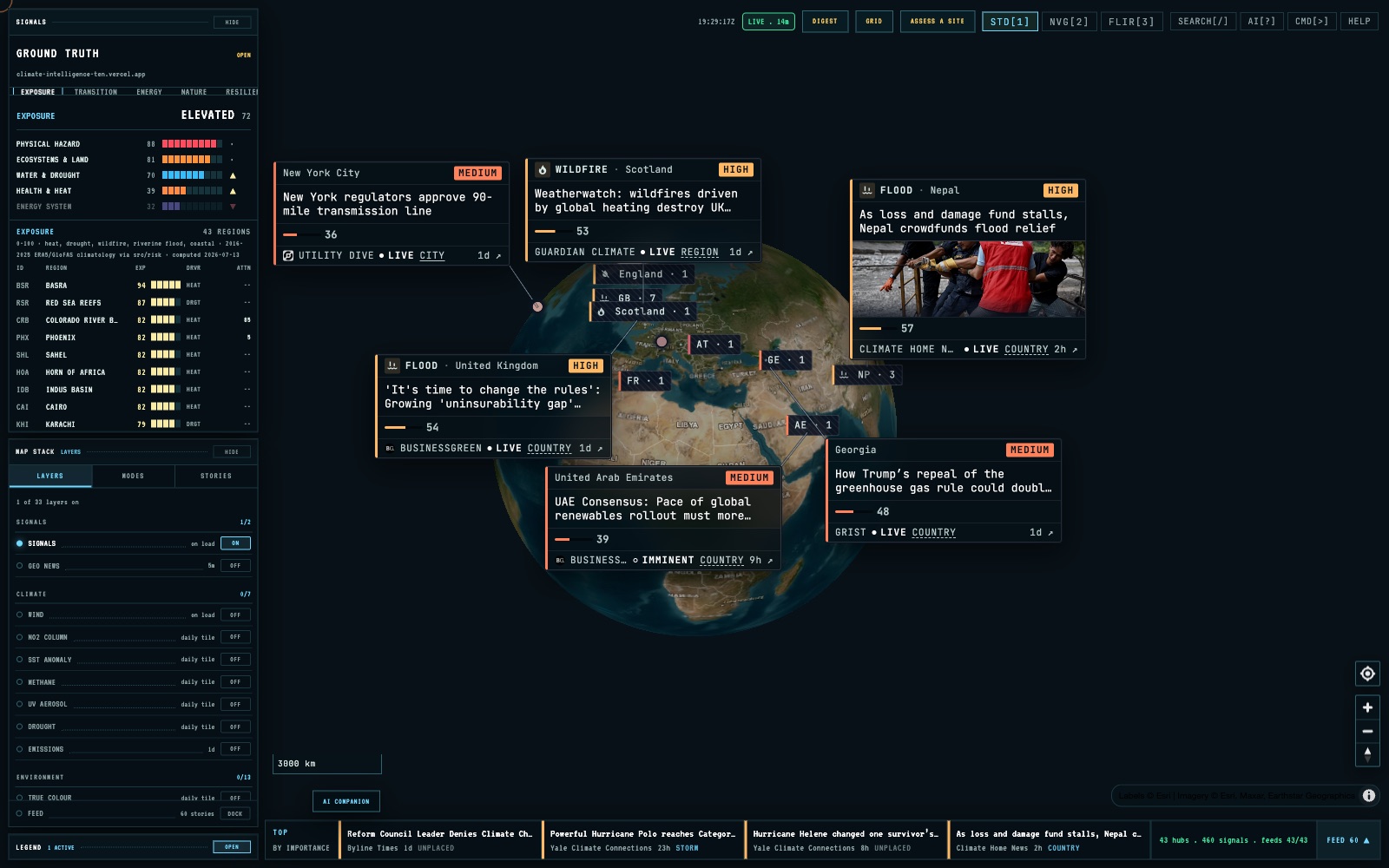
I developed the climate console, source adapters and Site Assess API, building on an earlier situational-awareness concept. I connected map layers, a Sentinel-2 preview through STAC and a per-location assessment that records its sources and missing coverage. I also exposed the same functions through read-only tools for agent access.
I developed the climate console, source adapters and Site Assess API, building on an earlier situational-awareness concept. I connected map layers, a Sentinel-2 preview through STAC and a per-location assessment that records its sources and missing coverage. I also exposed the same functions through read-only tools for agent access.
- An implemented map console for climate, hazard and energy context.
- Source adapters and a per-location assessment API with missing-data handling.
- Documented coastal and wildfire screening proxies, kept distinct from validated hazard models.
- A read-only agent tool surface and a catalogue of sources and licence conditions.
Where the work stands: An exploratory screening prototype. Coastal exposure uses an elevation proxy and wildfire screening uses hot/dry conditions; neither is a full hazard model. The tool does not estimate insured loss or establish financial risk, commercial adoption or continuously live data.
Geospatial Careers
A career product connecting geospatial job evidence with practical application and learning workflows.
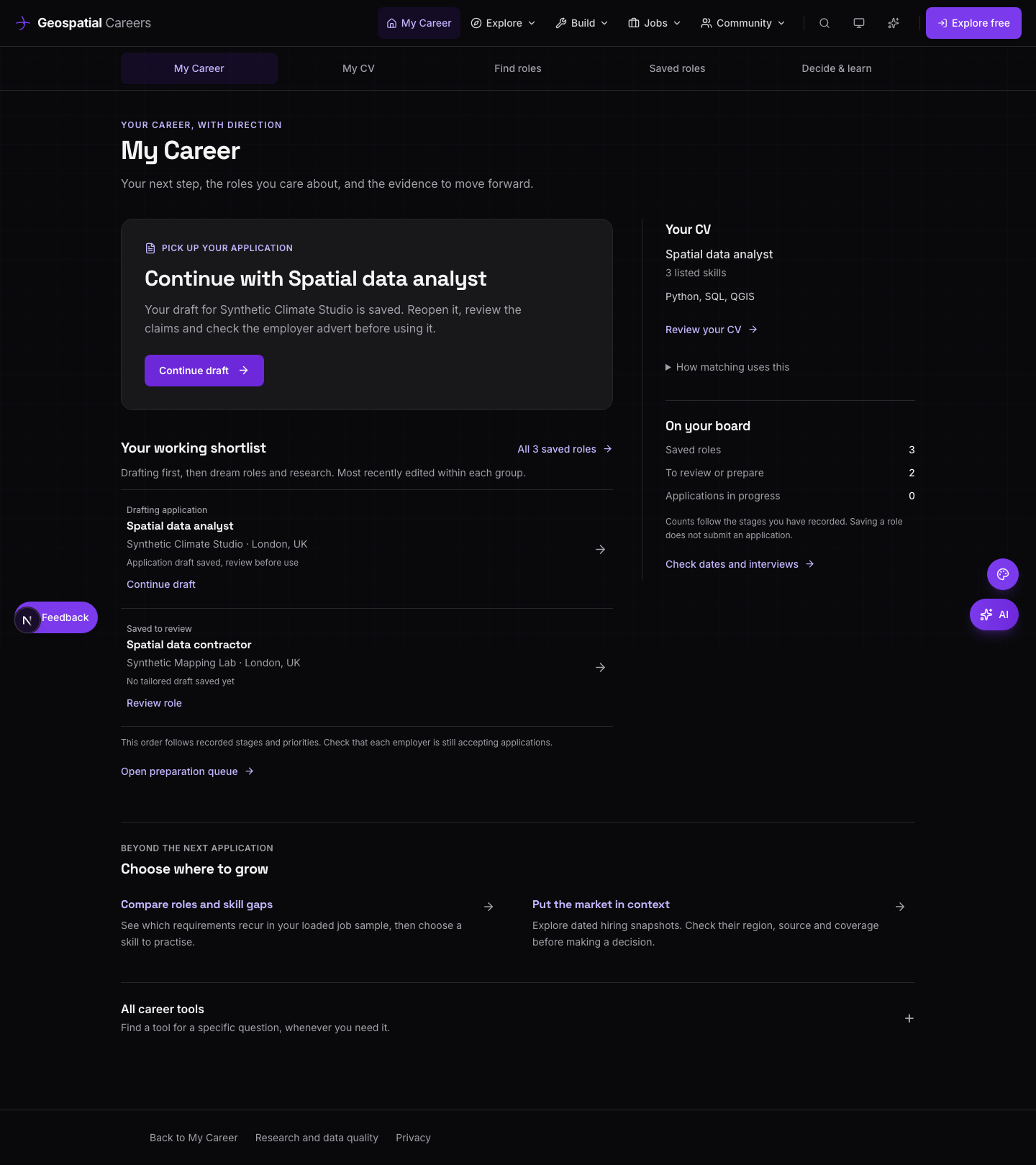
I designed and built the workspace and its supporting PostGIS and dbt data platform. The development version connects reviewed CV import, role search, saved applications, tailored CVs and cover letters, document exports and learning priorities. I designed the interface to distinguish a candidate’s stated experience from job requirements and missing information, then checked the connected journey using sample candidates.
I designed and built the workspace and its supporting PostGIS and dbt data platform. The development version connects reviewed CV import, role search, saved applications, tailored CVs and cover letters, document exports and learning priorities. I designed the interface to distinguish a candidate’s stated experience from job requirements and missing information, then checked the connected journey using sample candidates.
- A connected local journey from PDF CV import and review to saved roles, application preparation and learning.
- Actual CV and cover-letter DOCX exports checked against sample candidates, with saved edits reopened in a fresh mobile browser context.
- A responsive workspace with distinct guidance for new users, candidates with a CV and returning applicants.
- Research and career interfaces that expose source dates, pay periods, missing information and the basis of a match.
Where the work stands: The illustrated workspace is in development and uses sample data. Local journey checks do not establish production availability, complete job coverage or hiring outcomes. Matching supports shortlisting, not a calibrated probability of being hired.