Twenty Years on the Lower Lea
A two-hour walking workshop that reads twenty years of Olympic Park regeneration critically, on foot, where every engineer's phone becomes a voting booth and the walk itself is the data.
- Period
- 2026
- Status
- Delivered commission
- Role
- Artist and developer
- Scale
- Queen Elizabeth Olympic Park, London
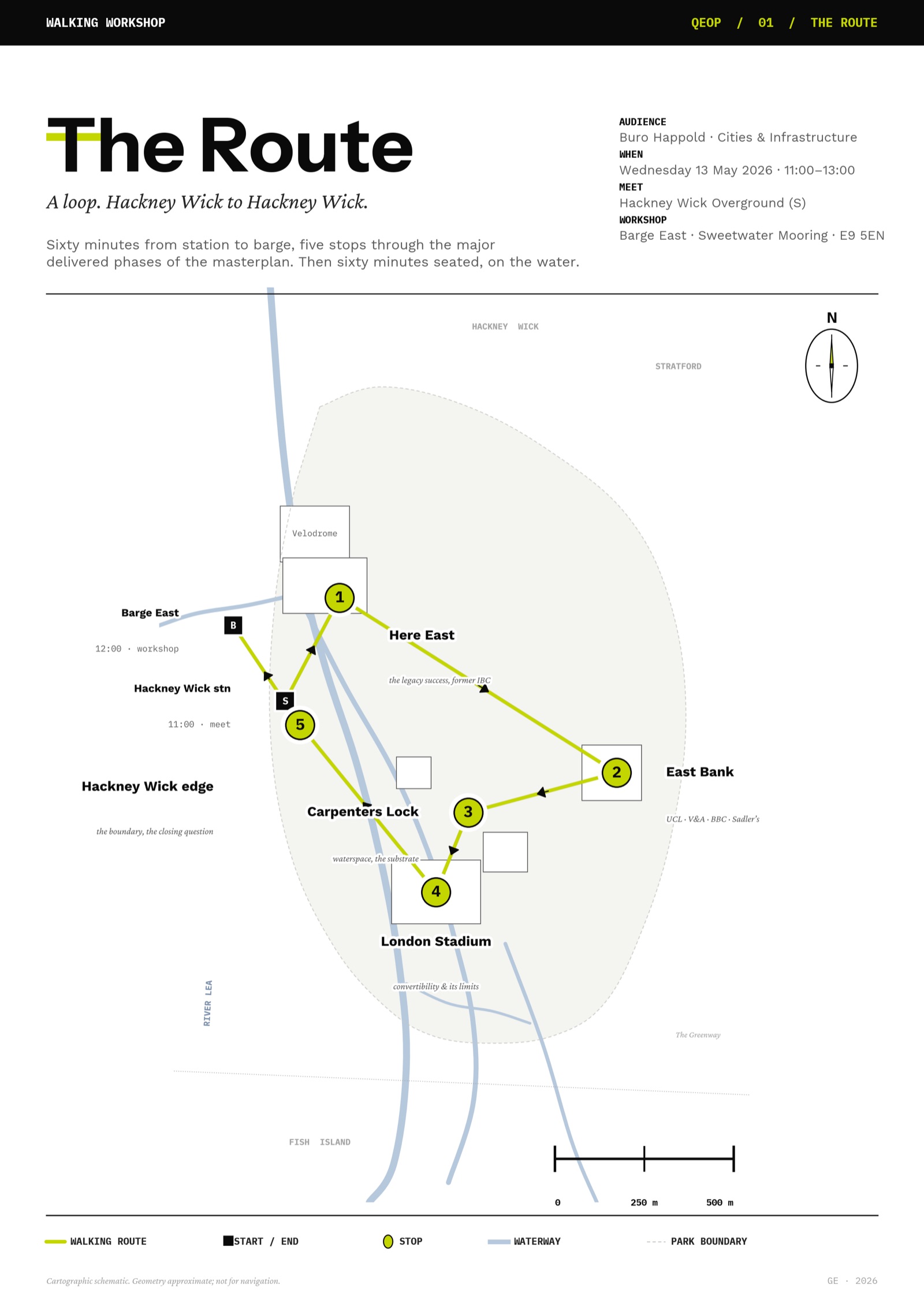
A twenty-year regeneration is almost always reviewed through its own success metrics, in a boardroom, after the fact. A leading built-environment engineering practice wanted the opposite: to have its own Cities and Infrastructure team read two decades of its work on the Lower Lea Valley critically, together, on foot. The real problem is participation. How do you get a moving group of around twenty-five people to hold engineering credibility and equity evidence open at the same time, produce a shared reading rather than a lecture, and do it in the two hours between a station and a canal-side venue?
My contribution
I conceived, designed and built the whole thing: the intellectual frame, the route, and two synchronised artefacts. I designed a five-stop clockwise loop that runs from the answer back to the question, pairing each engineering achievement with an equity counter-reading grounded in named sources (Bazalgette's Victorian substrate, Debord's derive as method, Hillier's space syntax, and Paul Watt's "it's not for us" as the empirical rebuttal). I built a 15-page A4 print companion and a standalone vector route map using WeasyPrint and Matplotlib, with a four-typeface system in which the type itself carries the dialectic (sans for the engineering voice, serif italic for the critical-theory voice, unbridged). I built the mobile companion as a Next.js 16 / React 19 / TypeScript app on Supabase Postgres with MapLibre GL, where every phone is a capture-and-vote surface: a MapLibre route with geofenced context zones (haversine radius triggers), a single Success / Tension / Synergies poll fired on arrival at each stop, photo and voice-memo capture, a projected live deck and an atlas of contributions, and a facilitator layer of timer, host call sheet and synthesis vote. Under it I engineered a local-first sync layer (optimistic local update, a localStorage retry queue with backoff, auto-flush on online and focus events) so a tap moves the bar instantly and nothing is lost on bad signal.
Decisions and constraints
Decisions I made
- Collapsed two separate polls into one. The original design had a per-stop four-option 'for whom' poll plus a separate three-bucket workshop reading; I unified them into a single Success / Tension / Synergies vote fired on arrival, so the walk populates the workshop and the room opens on live data instead of a blank slide. This traded granular 'for whom' percentages for sharper pedagogy, and I chose the pedagogy.
- Went local-first rather than trusting the network. On a moving group across patchy coverage, a round-trip before the bar moves kills the feeling of the room shifting with you, so votes, notes, photos and voice memos update optimistically and queue in localStorage with a retry backoff that replays on reconnect.
- Kept print and web as two artefacts with zero shared layout source, syncing only the content through one data module. A 15-page PDF and a realtime web app want radically different structure; unifying the layout would have compromised both.
- Let the type carry the argument and refused to bridge the two voices. Engineering claims get a number or a date, critical claims get a citation, provocations are labelled as the document speaking; there is no 'however' or 'on the other hand'. Holding the tension open, unresolved, is the workshop's job, not the document's.
- Reordered the route to a clockwise geographic logic after a reviewer flagged the earlier ordering as inefficient, which also sharpened the narrative arc from legacy success to legacy question.
Operating constraint
Two hours, a group of around twenty-five people in motion, patchy field cell coverage across the park, one projector and one venue, and a commissioner whose own work is the subject under critique. The document had to stay credible to engineers without softening the counter-evidence, and could not editorialise its way to a verdict.
Claim boundary: This records my concept, design and build. It was made iteratively through critique and delivered as a collaboration; the commissioning practice, the co-host and the participant contributions are kept private, and there is no public link because the app was a live event surface rather than a showcase. The participation figures describe the design target of a room of around twenty-five, not independently audited attendance.
What can be checked.
- Delivered and run as a live two-hour session for the practice's Cities and Infrastructure team, not a prototype: three Supabase migrations applied to production, poll writes returning HTTP 201, bars moving on tap.
- Two synchronised deliverables shipped: a 15-page A4 print companion plus a standalone vector route map (PDF, SVG and PNG, A3/A4 printable) with a compass rose drawn in figure coordinates, and a mobile web companion deployed to Vercel.
- A full application, not a demo: around fifty React components, a Supabase schema with row-level security, realtime publication and read-only aggregate views, and Playwright end-to-end specs covering critical flows, print quality and the equity spine.
- A local-first sync layer with an optimistic update path, a persisted retry queue and auto-flush on reconnect, plus three geofenced context zones using haversine distance that surface a 30-second card on the path between stops.
- Every critical claim carries a verbatim citation (Watt 2013, City 17(1), with DOI; Debord 1958; Hillier 1984 and 1996) and every engineering claim a number or date; the brand lime was verified against source, coordinates against Google Places, and the cover quote transcribed verbatim from the interview record.